
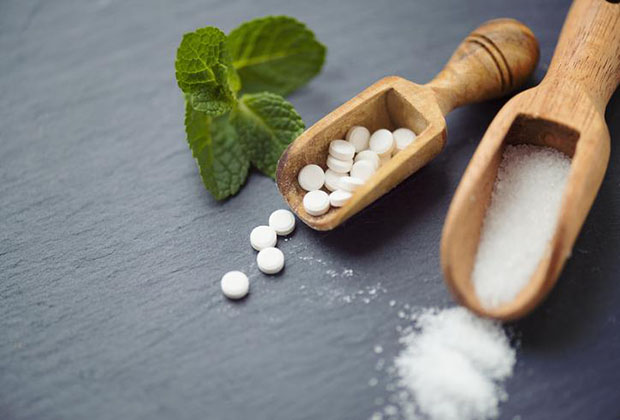
Artificial sweeteners are low-calorie chemicals that are used instead of sugar to sweeten foods and beverages. They are found in thousands of products, from beverages to desserts and ready meals, cakes, chewing gum and toothpaste.
People often refer to them as “intense sweeteners” because they taste like table sugar, but are several thousand times sweeter. Although some sweeteners contain calories, the amount needed to sweeten foods is so small that you consume almost no calories.

Approved sweeteners for use in many countries include:
- Acesulfame Potassium
- Aspartame
- Saccharin
- Sorbitol
- Sucralose
- Stevia
- Xylitol
Are artificial sweeteners a healthy food additive?
Artificial sweeteners are often the subject of heated debate. Both the UK Cancer Research Institute and the US National Cancer Institute have stated that sweeteners do not cause cancer.
“In a large number of studies in humans, we have found strong evidence that artificial sweeteners are safe for humans,” says the UK Cancer Research Center.
All sweeteners in the EU are carefully tested for safety by the European Food Safety Authority (EFSA) before they can be used in food and beverages.
Sweeteners may be safe, but are they healthy? Food manufacturers claim that sweeteners help prevent tooth decay, control blood sugar levels and reduce our calorie intake. The EFSA has confirmed the health claims made about xylitol, sorbitol and sucralose, including in relation to oral hygiene and blood sugar control.
But research on sweeteners shows that eating or drinking them as part of a healthy diet is perfectly safe, says nutritionist Carder.
“Artificial sweeteners are a really useful alternative for people with diabetes who need to watch their blood sugar levels when they still want to enjoy their favorite foods.”
“Sweeteners taste like sugar, but what sets them apart is that they do not raise blood sugar levels after consumption,” he says.

It is said that the use of artificial sweeteners may have a stimulating effect on appetite and thus play a role in weight gain and obesity. But research on sweeteners and appetite stimulants is contradictory. In fact, there is little evidence from studies to show that sweeteners cause weight gain.
How do artificial sweeteners work?
The surface of your tongue is covered by many taste buds, each containing several taste buds that recognize different flavors.
When you eat, your taste buds are exposed to food molecules. The perfect fit between the receptor and the molecule sends a signal to your brain, allowing you to recognize the taste.
For example, the sugar molecule is perfectly located in your sweet taste receptor and allows your brain to recognize the sweet taste. Artificial sweetener molecules are similar enough to sugar molecules to fit on a sweetener.
However, they are generally very different from sugars and your body can not break them down into calories. In this way, they add a sweet taste without calories. Only a handful of artificial sweeteners have a structure that your body can break down into calories. Since you only need very small amounts of artificial sweeteners to sweeten the taste of food, you consume almost no calories.
In general, the use of artificial sweeteners has few risks and may even have benefits for weight loss, blood sugar control and dental health. These sweeteners are especially useful if you use them to reduce the amount of sugar added to your diet.
Effects of artificial sweeteners
- Effect on appetite
Recent studies have shown that replacing sugary foods or beverages with artificially sweetened foods can reduce hunger and thus burn extra calories.
- Impact on weight
Replacing sugary foods and drinks with artificial sweeteners can help you lose weight.
- Artificial sweeteners and diabetes
Artificial sweeteners can help people with diabetes reduce their sugar intake. However, more research is needed on the effects of artificial sweeteners in different populations.
- Artificial sweeteners and metabolic syndrome
Artificial sweeteners are unlikely to increase the risk of metabolic syndrome. Replacing sugary drinks with artificially sweetened beverages can reduce the risk of several known diseases.
- Artificial sweeteners and cancer
Based on global evidence and research, artificial sweeteners are unlikely to increase the risk of cancer in humans.
- Artificial sweeteners and dental health
Artificial sweeteners reduce the risk of tooth decay when used instead of sugar.
Safety and side effects
Synthetic sweeteners are generally considered safe, but people with phenylketonuria or allergies to sulfonamides should avoid them.
Related Articles:
