
Ammonium bicarbonate is an inorganic salt commonly used in industry. This salt can be formed by combining gaseous carbon dioxide and aqueous ammonia.
Ammonium bicarbonate is used in the food industry to enhance baked goods, such as biscuits and crackers. This material was usually used at home before putting baking powder.

History of ammonium carbonate
Ammonium bicarbonate was made in the Middle Ages by the burning or dry distillation of creatine-containing materials (creatine is a structural protein found in the animal kingdom). They did this by heating the crushed horns, venom, skin, and even mammals’ urine in lime kilns (kilns made to heat limestone). It is a production process that dates back to Greek and Roman times to turn raw lime into a building material.
After the stoves had cooled, waste was collected. Because wood ash was often boiled in water and used as a paste agent, these ashes may have been used in the same way. It was used to treat fever, various stomach diseases, especially diarrhea, fever and various types of bites.
The name was especially important in the Middle Ages, when people believed that the salt collected from burning certain parts of the animal had a special medicinal value. It was a commonly smelled salt in the days of Queen Victoria.
Properties of ammonium bicarbonate
Ammonium bicarbonate is an inorganic compound; chemically, it is an ammonium ion bicarbonate salt. Thanks to its physicochemical properties, it is used as a fermenting and stabilizing agent and as an acidity regulator.
The stabilizing properties of ammonium bicarbonate make it possible to maintain ideal physical and chemical properties in a food. In addition, it has the ability to regulate the pH by controlling or modifying the acidity or alkalinity of a food.
Finally, as a kneading agent, ammonium bicarbonate, alone or in combination with others, has the ability to release gas while increasing the dough and dough volume for baked goods.
Specification
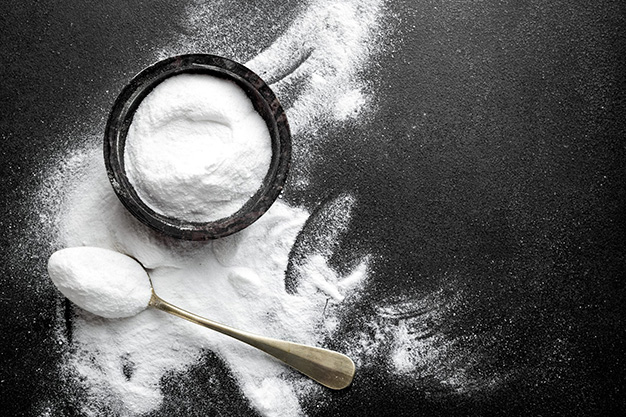
Appearance : Colorless or white crystals with a faint odor of ammonia
Melting point : 95 degrees Fahrenheit (35 degrees Celsius)
Solubility : Easily soluble in water. Soluble in ethanol
Decomposes with the formation of ammonia gas above 34 ° C
Function
Ammonium bicarbonate can release ammonia and carbon dioxide and cause cooling gases to react without reacting with the dough acid. First, it decomposes spontaneously in this substance and ammonia, and in the next stage, it is converted to ammonia gas and carbon dioxide:
NH4HCO3 → NH4HCO3 + NH3
Application
The use of ammonium bicarbonate is mentioned in old cooking recipes. Especially, in Scandinavian gingerbread, Polish ammonia cookies and traditional German Christmas cookies.
The advantages of using this substance in cooked products include the following :
- Absence of alkaline flavor residues often observed with sodium bicarbonate
- Does not affect the pH of cooked goods
- In products cooked with high humidity (more than 5%), ammonium bicarbonate may cause an ammonia flavor. That is why it is more suitable for low moisture products such as biscuits, crackers, cookies and waffle cones.
Ammonium carbonate is used for dough in cookies, flat biscuits or crackers. In German cooking it is known as hirschhornsalz or hartshorn and it is also called baker’s ammonia. On the other hand, it leaves no residue of the salty and similar taste of soap, because it is completely decomposed into ammonia and carbon dioxide.
How to use ammonium carbonate
Ammonium carbonate is usually mixed with the liquid before being added to the dry matter, so that it dissolves well and mixes thoroughly. It should be kept dry and in a sealed container, as it easily absorbs moisture and accumulates, so put a small amount in warm water to determine if it is still active.
If it bubbles heavily, you can use it in your recipes. Typically, this substance is mixed with liquid substances to ensure its dissolution before mixing in the dry mixture. In some formulas, it is used with 30-50% baking soda.
Alternatives
If ammonium carbonate is not available, baking powder can be substituted in a 1: 1, 1: 2 or 1: 3 ratio. You can also add some baking soda with baking powder.
Production method and chemical formula
Today, white powder is chemically produced by heating ammonium chloride or ammonium sulfate with gypsum.
Hirschhornsalz is a mixture of three molecules :
- Ammonium carbonate (NH4) 2CO3 → 2NH3 + CO2 + H2 O
- Ammonium bicarbonate NH4 HCO3 → NH3 + CO2 + H2 O
- Ammonium carbonate (Figure 2) NH4 NH2 CO2 → 2NH3 + CO2
These molecules are converted to ammonia, carbon dioxide and (water) by heating to 140 F (60 ° C) or higher. Before setting the dough, the gases lift the dough, which contains air bubbles due to whipping, as it rises to the surface of the dough, causing it to swell. As the dough settles, bubbles remain, but ammonia, carbon dioxide, and steam escape from the cooked product and are dispersed in the kitchen air.
Baker ammonia can react with some of the sugars and amino acids in dough and produce very small amounts of acrylamide, a carcinogen. For this reason, excessive and excessive consumption is not recommended.
Recipes with ammonium carbonate
If you want to see how to use this ingredient, try making these sweets :
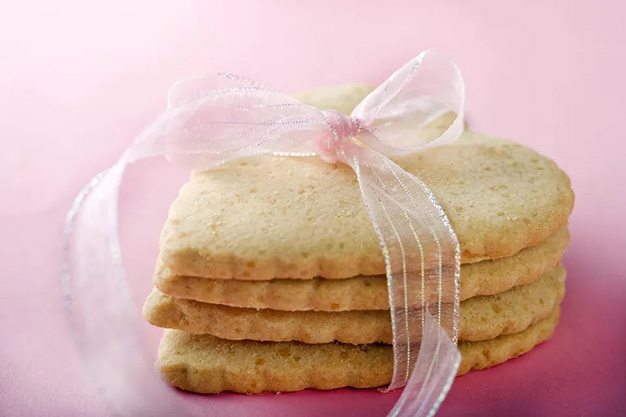
Polish Ammonia Cookies: These sugar cookies have a crisp texture due to ammonium carbonate.
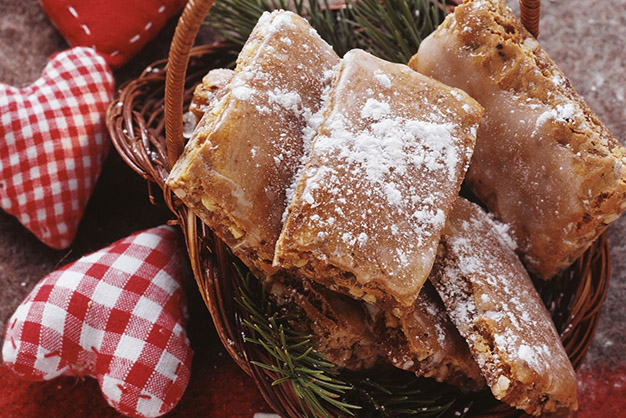
Swiss-German Basler Leckerli: These Swiss-German Christmas cookies can be stored for weeks. This dry dessert is full of nuts and sweet orange peel.
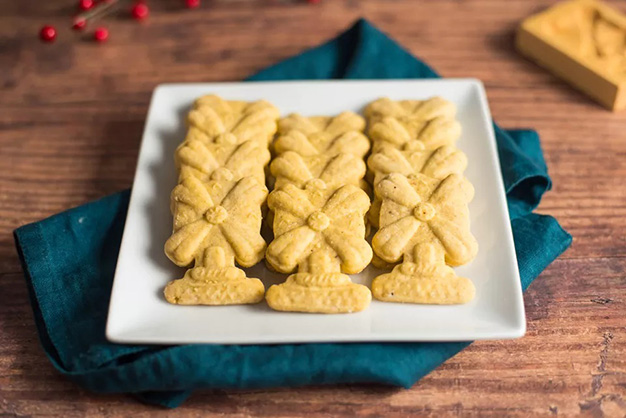
Spekulatius Cookies: These sweets are a traditional Christmas cookie in Germany and are also called speculas in the Netherlands. They are traditionally formed in a wooden mold, but you can also use cookie cutters instead.
Other names for ammonium bicarbonate :
- ABC-Trieb (ammonium bicarbonate)
- E503ii (EU Food Additive)
- Baker ammonia
- Hart Horn
- Hartshorn
- Hornsalt
- Ammonia bicarbonate
- Ammonium hydrogen carbonate
- AmBic
- Baking ammonia powder, ammonia bicarbonate salt
- Deer antler salt
INCI: Ammonium bicarbonate
Chemical formula: NH4HCO3
Product CAS number: 1066-33-7
Molar weight: 79.055g / mol
Learn more about ammonium bicarbonate
Ammonium bicarbonate is a white powder that is used as a kneading agent and is added to various types of baked and crunchy products, such as puff pastries, flat breads, crackers, biscuits, etc. During the cooking process, there may be an odor and smell of ammonia, but this odor does not remain when eating cooked goods and does not attract attention.
The result of using ammonium bicarbonate is a light, crispy and somewhat fluffy cooked product. Today we have replaced baking powder or baking soda.
Ammonium bicarbonate is activated when added to a pastry or dough mixture and heated to room temperature or baked in the oven, because heat is a catalyst that activates a chemical reaction that produces gases. The chemical reaction releases a gas (ammonia) that causes the cooked goods to swell.
Keep the sweets in an airtight container like a glass jar with a lid. You can store it for years when stored in a cool, dry place. When a recipe suggests the use of ammonium bicarbonate, you can replace it with equal amounts of baking powder if necessary. To check if it is still active, add a tablespoon of ammonium bicarbonate to some lemon juice or vinegar to see if gas is produced. If this is not the case and no gas is produced, it is out of date.
Uses of ammonium bicarbonate
Ammonium bicarbonate can be used in food, beverage, pharmaceutical, health and personal care, agriculture, animal feed and poultry. Ammonium bicarbonate is used as an enhancer in flat baked goods such as cookies and crackers and other similar applications in the food industry.
Compared to baking soda, ammonium bicarbonate does not affect the taste of flat baked goods. Ammonium bicarbonate can also be used in the production of plastics and rubber as a fire retardant. In the fertilizer industry, ammonium bicarbonate can be used as a cheap source of ammonia.
Ammonium bicarbonate is used as follows:
In food
Ammonium bicarbonate can be used as a puff and food processor for flat baked goods such as cookies and crackers.
In the drink
Ammonium bicarbonate can be used as a foaming agent in beverages
In Pharmacy
Ammonium bicarbonate is widely used in the production of pharmaceuticals
In products related to firefighting
Ammonium bicarbonate is used in preservatives in fire extinguishing capsules
In the manufacture of compact sponges
Ammonium bicarbonate is used in the manufacture of foam rubber sheets and strips
In personal health and care
Ammonium bicarbonate can be used as a pH regulator and buffer (stabilizing the pH of the product)
In agriculture, animal feed, poultry feed
Ammonium bicarbonate can be widely used in agriculture, animal feed and poultry feed
In other industries
It is also used as a fertilizer, pH buffer and reagent in chemical laboratories. Some other items in the industry are for the production of paints, drugs, catalysts, ceramics, fire retardants, plastics and other products.
Recommendations for ammonium bicarbonate
Ammonium bicarbonate and sodium bicarbonate are the most common additives used as kneaders in the bakery industry because they release carbon dioxide when they reach specific temperature and humidity conditions.
In general, when ammonium bicarbonate is used, it decomposes at more than 40 ° C, releasing CO2, H2O and NH3. Other chemical agents are added to prevent the effects of ammonia on the products.
In the case of ammonium bicarbonate, its daily intake and acceptable standard (ADI) are not specified by the Joint Food Additives Committee FAO / WHO (JECFA), as its use does not pose a risk to food safety.
Related article :
