
Aspartame is a synthetic non-saccharide sweetener that is 200 times sweeter than sucrose and is commonly used as a sugar substitute in foods and beverages. This substance is one of the most popular artificial sweeteners on the market.
The compounds of aspartame are aspartic acid and phenylalanine, both of which are natural amino acids. Aspartic acid is produced by your body and phenylalanine is an essential amino acid that you get from food.

When your body processes aspartame, some of it breaks down into methanol. Consumption of fruits, juices, fermented beverages and some vegetables also contain or lead to the production of methanol.
Aspartame was first developed in 1965 and approved by the US Food and Drug Administration (FDA) in 1981 for use in food products.
History of Aspartame
Aspartame was discovered in 1965 by James M. Schlatter. He was a chemist who worked for G.D. Searle & Company. Schlatter had synthesized aspartame as an intermediate step in the production of a tetrapeptide of the hormone gastrin for use in the evaluation of an antihypertensive drug. He noticed the sweet taste when he licked his finger, which had some aspartame stuck to it, to remove a piece of paper.
Torunn Atteraas Garin later participated in a project to produce aspartame as an artificial sweetener.
In 1975, because of issues with Flagyl and Aldactone, a team at the US FDA reviewed 25 studies provided by the manufacturer, including 11 for aspartame. The team reported “serious deficiencies in operations and practices.”
But the FDA sought to confirm 15 of the studies presented with the new data. Finally, in 1979, the Center for Food Safety and Applied Nutrition (CFSAN) concluded that since many problems with aspartame studies are minor and do not affect conclusions, these studies can be used to assess the safety of aspartame. .
In 1980, the FDA formed a General Investigation Board (PBOI) consisting of independent consultants tasked with examining the apparent link between aspartame and brain cancer. The PBOI concluded that aspartame did not harm the brain, but at the time, citing unanswered questions about cancer in mice, it was recommended that aspartame not be approved.
In 1983, the FDA approved aspartame for use in carbonated beverages and in 1993 for use in other beverages, baked goods, and confectionery. In 1996, the FDA lifted all restrictions on aspartame and allowed it to be used in all foods.
Several EU countries approved aspartame in 1980 with the approval of the European Union in 1994. The Scientific Committee of the European Food Commission reviewed further safety studies and announced its reaffirmation in 2002.
Uses
Aspartame is about 180 to 200 times sweeter than sucrose (regular sugar). Due to this property, even if aspartame produces 4 kcal (17 kJ) of energy per gram during metabolism, the amount of aspartame required to produce the sweet taste is so low that its caloric content is negligible. The taste of aspartame and other artificial sweeteners is different from the taste of sugar, although aspartame is closer to the taste of sugar among the approved artificial sweeteners.
The sweet taste of aspartame lasts longer than sucrose, so it is often mixed with other artificial sweeteners such as potassium asulfame to make it look more like sugar.
Aspartame may be hydrolyzed to its constituent amino acids under high temperature or high pH conditions. This makes the use of aspartame as a sweetener in cooking undesirable and prone to degradation in products with high pH, if necessary for a long shelf life.

The stability of aspartame under heat can be partially improved by confining it to fats or maltodextrin. Stability when dissolved in water depends significantly on pH. At room temperature, it is more stable at pH 4.3, where it has a shelf life of approximately 300 days. But at pH 7, it lasts only a few days.
The pH of most beverages is between 3 and 5, where aspartame is reasonably stable. In products that may require longer shelf life, such as syrups and spring drinks, aspartame is sometimes mixed with a more stable sweetener such as saccharin.
Descriptive analysis of aspartame-containing solutions reports sweet taste and bitter and tasteless taste. In products such as powdered beverages, the amine in aspartame can experience Millard reactions with aldehyde groups in certain aromatic compounds. By protecting the aldehyde as a stable, the reduction of taste and sweetness can be prevented.
Consumption Standard
The ADI (acceptable daily dose) for aspartame, like other dietary supplements studied, is a dietary supplement based on body weight that can be taken daily throughout life without significant health risk.
The FAO / WHO Joint Committee on Food Additives (JECFA) and the European Commission Scientific Committee on Food have set this figure at 40 mg per kilogram of body weight for aspartame, while the FDA has set the ADI for Aspartame is 50 mg.
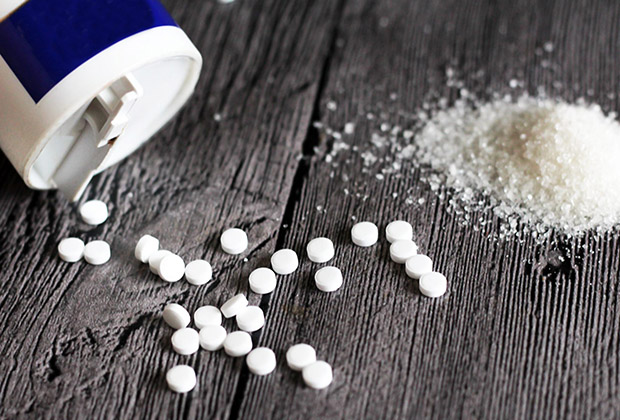
The main source of aspartame in the United States is diet drinks, although it can be found in other products such as medicines, fruit drinks and chewing gum in smaller quantities.
One 12-ounce (355 ml) can of diet soda contains 0.18 grams (0.0063 ounces) of aspartame, and for an adult weighing 75 kilograms (165 pounds), approximately 21 cans of diet soda per day are required to consume 3.7 grams (0.13) ( Of course, this example is just to understand the required amount of aspartame, otherwise there are definitely other substances in diet drinks that their high consumption will not be desirable)
Aspartame use has been studied in countries around the world, including the United States, European countries, and Australia. These studies have shown that even high doses of aspartame (which has been studied in several countries) are much lower than ADI for safe use. Studies have also shown that populations thought to be consuming large volumes of aspartame, such as children and diabetics for safe use, are below the ADI, even taking into account the highest dose.
In a report released on December 10, 2013, the EFSA stated that, after extensive investigation, it had ruled out “potential aspartame risk of gene damage and cancer” and that aspartame levels in diet drinks were Knows safe consumption.
Should I use aspartame to lose weight?
The use of aspartame or any kind of artificial sweetener to lose weight is a hotly debated topic. Dietitians, nutritionists and health professionals often oppose the opposition.

Some studies have shown that when dieters use artificial sweeteners to reduce calories, they can successfully lose weight. But other studies have shown that using a high-intensity sweetener such as aspartame can change the taste of food and make you eat sweet and unhealthy foods.
Most researchers believe that more research is needed before we can know for sure whether artificial sweeteners are good for weight loss.
However, if you are familiar with your body, you probably already know that you will feel better during the day if you drink a diet drink or a piece of candy. If a low-calorie or low-calorie dessert is satisfying and feels good and helps meet your nutritional needs, it is important for you to follow a diet plan and you should pay attention to it.
To buy aspartame or to know the price of aspartame, contact the experts of the collection through our contact us page.
Related Articles:
